Black culture is in a lot of ways synonymous with how internet culture exists writ large. From what is now described as “Gen-Z slang” (or as Black people have always known it, AAVE) to our methods of organizing (Black feminists starting hashtag activism and creating movements like #MeToo, #BlackLivesMatter, and #SayHerName) and even how we observe and criticize entertainment (#OscarsSoWhite coined by April Reign). This contributes to not only what becomes the standard on a digital platform but also what the platform is defined by. It is impossible to think about TikTok without thinking about the Renegade— a dance created by Jalaiah Harmon or Tanara’s “Everybody’s So Creative,” both of which became content far beyond the original platform and served as markers for what other users would make the norm.
But as the culture moved faster and became more accessible, so did those who wished to harm or exploit it. In 2006, Joshua Limpkin Green coined the term Digital Blackface to describe how technology allows non-Black individuals to assume Black identities. This was later expanded to describe how non-Black people use pictures, GIFs, or videos of Black people to convey their own emotions or thoughts, as well as describe the desire for non-Black people to use imagery that describes Black people as violent, loud, obnoxious, “ghetto,” etc.
As violence continued to be the norm in online spaces, Black and other marginalized communities developed methods (digital check-ins, block parties, and report campaigns, for example) to keep each other safe. Social media platforms have insisted that the toxicity online is a reflection of human behavior instead of a failure to recognize (online) safety as a human right for all users rather than some.
The culture of today
In 2026, Digital Blackface has been studied across the world, and yet social media platforms have refused to adopt any of its definitions to cultivate an environment for those tastemakers mentioned earlier to thrive on their platforms without harassment, and although Black people are the most harassed online, no mainstream social media platform has adopted any language to specifically protect Black users from anti-Black harassment or misogynoir. Instead, Black users are fooled into thinking that they have the opportunity to report accounts or posts that are in violation of Hate Speech policies, only to be met with automated responses that there has been no issue found. In fact, research by Lee et al. (2024) found that racial discrimination disclosures were disproportionately flagged as toxic by both automated moderation systems and human users, meaning Black folks are suspended more often when talking about racial discrimination.
According to this article, Instagram users who are suspected to be Black are 50% more likely to receive an account suspension compared to their white counterparts, and on Facebook, users have received account suspensions that last for weeks or months for reporting that they were silenced when discussing racism on the platform. Similarly, on X, users found out that racial slurs can be used as usernames and not be taken down by automated moderation systems, even if reported by users. As I discussed in my article Traditional Social Media as a Prison, the culture of today relies on a prevalence of anti-Black content or otherwise negative content about marginalized communities on social media to cause more interaction, which brings profit to the platform.
This culture is defined by a cycle of invitation (a platform sets out to attract power users from marginalized communities who can bring a culture by promising to be different than other platforms), excitement (power users attract other users to the platform who create content), exploitation (marginalized communities receive harassment, abuse, and are removed from algorithms when they speak up), and eventually disappointment (realizing that although a social media platform promised to be different, the racial subjugation remains the same). This cycle is a pattern that can be observed throughout the history of social media, from early platforms like Vine to the ones we use today.
Safety is a human right
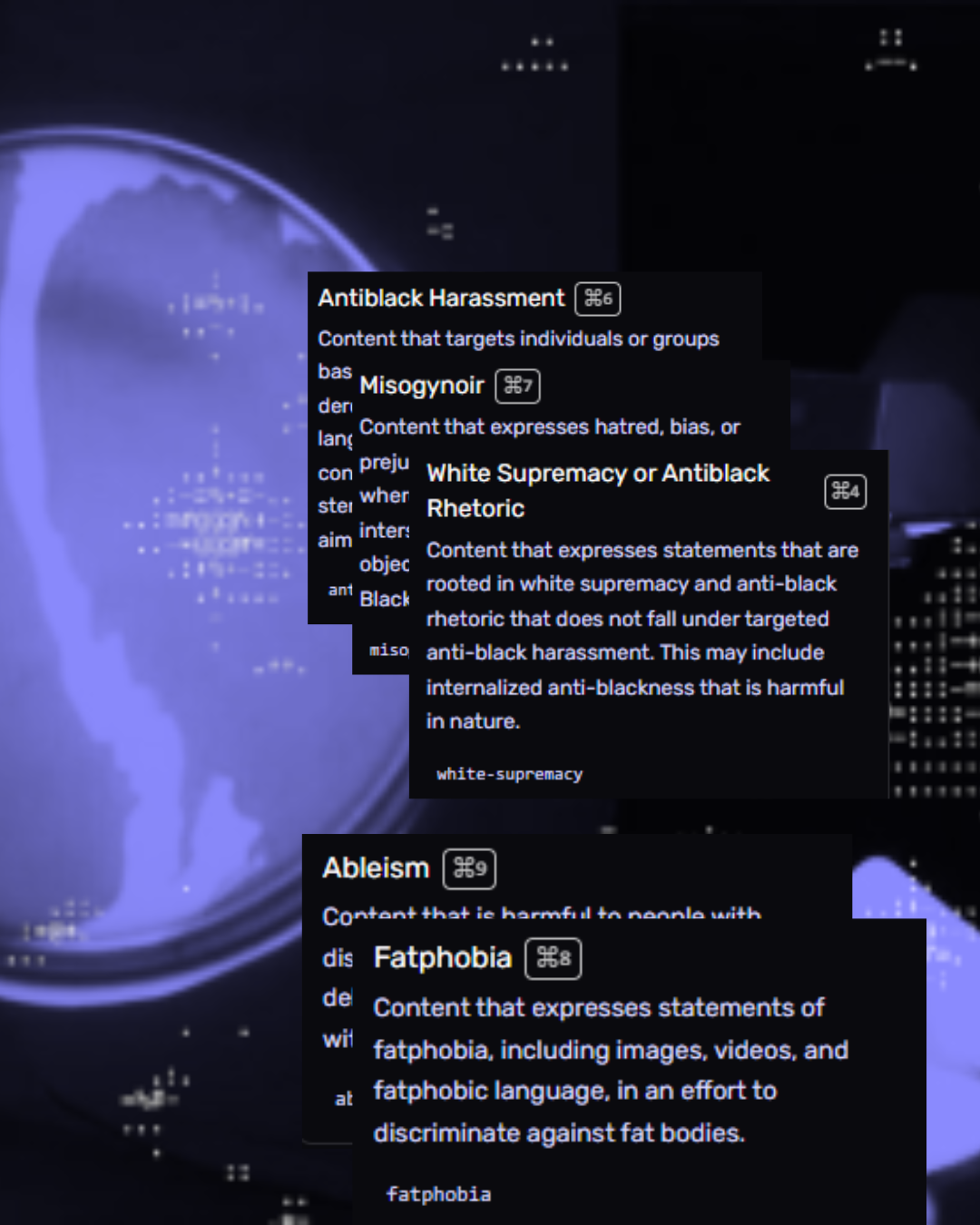
Instead of relying on Trust and Safety teams of larger social media platforms to catch up to what Black and other marginalized groups need to thrive or to “create a better internet”, Blacksky took up that mission. Recently, we’ve launched a label for Digital Blackface as one of the many labels against anti-Black violence (like digital misogynoir and anti-Black harassment, for example) to ensure that members of our community have tools at their disposal to report content that seeks to harass or racially antagonize them.
Blacksky’s community works together with our Trust and Safety team by collaboratively voting on new labels via our People’s Assembly tool. This ensures that the community is part of the decision-making process and that we come closer to a digital third space where people feel safe to share content, direct message (DM) each other, and maybe even connect offline. The culture of tomorrow isn’t platforms deciding what protections should be available to people; it’s people coming together and collectively deciding on what tools should be available to feel safe.
Traditional social media platforms have treated safety as a marketing campaign or a PR move, which can only happen in a world that has decided that it is a privilege to feel safe, rather than one that ensures that it is a human right that everyone deserves. Our ancestors were able to create autonomous spaces in a world that sought to destroy them, and it is that technology that will enable us to build worlds beyond the one that currently exists. Black culture throughout the diaspora has the right to exist, thrive, and be celebrated online without its inheritors and cultivators becoming digital refugees when social media platforms decide to revoke its users’ privilege to be safe.